Showing posts with label a. Show all posts

Monday, August 21, 2017

It was a room of a hundred thousand windows each one looking out onto a different world


I could quite easily rob a library. It's one of the only places I would happily rob. Whenever I go the urge to sweep every book in the YA section into the hood of my hoodie or under my hoodie preggo style is unbearable. I CONFESS. I am a book lover, a bookworm if you will. I can read a whole book in a day and forget to breathe. Skip meals and construct a soundproof bubble around me so when my mum tells me to tidy my room for the hundredth time, her voice simply bounces off me. Useful. 


"You can start reading pink books now." BAM. I made it. Straight to the top. The top row of books in the school library were mine all mine. You see the pink books were the clever books, the books with the dramatic plots, small words, no pictures, LOTS of pages. Clearly these books were only readable by those who were strong mentally and could take the tragedies and heart racing dramas. I was prepared. I was excited. JACQUELINE WILSON WAS MINE. Corgi Yearling? KMT. Drop that Yearling and place a Corgi single in my hands. Eat your heart out Biff Chip and Kipper. The Very Hungry Caterpillar? Eat cake. Louise is ready for the big ones.


The school library was good, for school. But it didn't beat our Shenfield Library, and was a speck of dust on the shoulder of Brentwood Library, and we knew it. When the librarian from Shenfield came to our school to tell us about the new books we knew our library was NOTHING compared to this. The Summer Reading Challenge was EVERYTHING. The ultimate competition (excluding the easter egg challenge obv) at school. Who would read the 6 books and get the medal? 1 book a week? Bring it. Commence the staring down at classmates you see at the library, getting their record stamped. 


Mum took us to the library about once a month when we were little. We'd be allowed 6 books out every time but when she caught me amongst the beanbags with a pile of 9 and already half way through one while flicking through the bottom shelf between pages, she gave in and helped me carry them to the desk. Occasionally I'd drop hints and borrow 7 books about cats. Never worked. Book Week at school was the best because we got a book voucher. I could BUY a book. The only other times I could actually own a book was my birthday and Christmas, or when we went on holiday. Mum would pack my bag and hide books and magazines for the plane. Amazing. The trouble with buying books was that I could never choose just one, and I couldn't buy more than one because it was too expensive and my book voucher couldn't take it. Back to the library.


Around 400 libraries are due to be closed by the government. That's MILLIONS of books gone. What are they going to do with them? Burn them? Turn them back into trees? When reading through tweets about the #savelibraries campaign this morning I stumbled across author Joanne Harris who was doing storytime and has let me use her tweets in this post. She told the story perfectly... 


Once upon a time, in a village like yours, there lived an old librarian. (A librarian is a person who studies hard to do a professional job and is paid relatively little. Bit like an independent bookshop owner.) Lots of people loved the library. (A library is a place full of books that anyone can borrow, for FREE. You just read them, and then bring them back. And every time you borrow a book, the author gets paid a tiny bit of money. This helps authors keep writing). 


Anyway, kids loved the library because the old librarian (who liked stories) used to have storytime every day. Students loved the library because they could do their homework there - and meet girls, or boys, who liked to read (totally the best kind). Old people loved the library, because they could meet their friends there, borrow books that had gone out of print, and have a cup of tea. Some old people lked to borrow books that their children deemed UNSUITABLE for them, like LOLITA. It was allowed. No-one stopped them. Readers' groups loved the library, because authors used to do readings there and answer questions about their books. And the librarian loved the library, because it was his life's work. It looked like a room full of old books, but actually it was a room of a hundred thousand windows, each one looking out onto a different world. 


But there was one person who didn't like the library. This was the Mayor of the village. It wasn't that the Mayor didn't like books. I fact, he owned several. He also had a library of his own - well, not quite a library. These were all the Mayor's own books, bought in bulk by his interior designer. None of them were ever lent out, and of course, there was no librarian. And the Mayor said: "The library is old. The roof leaks. It's outdated. There are books in there that haven't been taken out for years." And he said: "We have to make CUTS. We have no choice. It's either the library or the school, or the old peoples' home. Or the poor." And because the Mayor was Mayor (as well as being very rich), the villagers believed him, and really thought they had no choice. Some people suggested that the cuts might not be necessary as the Mayor seemed to think. Some even suggested taking the BANKS instead of the poor, but they were quickly dismissed as radicals. Some well-meaning people said that cutting POVERTY was surely the priority...but poverty has more than one face, thought the old librarian. Some things can't be bought with money. And so he protested - timidly. He was a very polite old librarian. But what can one old librarian do? "We can't fight PROGRESS," said the Mayor. "We have to TIGHTEN OUR BELTS." (In fact the Mayor's belt was already tight, but this was simply because he was very, very fat.) Things looked hopeless for the old librarian, and for all those in the village who couldn't afford a private library like the Mayor's. And that's enough storytime for now. Will the old librarian win? Or will it be the fat Mayor? Cont'd after lunch. Bring cake. x


Today is Save Libraries day. Libraries up and down the country are holding protests, having author talks and mass readings. The acts themselves may not save the libraries but the unison of people showing how much libraries are loved will definitely prove that they are SO needed. Now hush up, Scarlett is lost in America and I need to put myself in her shoes for the next few hours, amongst the beanbags... #savelibraries


Sunday, August 20, 2017

How to Disarm a Borderline Part VIII Splitsville


Before reading this post, particularly if you are going to try this at home with a real adult family member with borderline personality disorder (BPD) (which is not recommended without the help of a therapist), please read my previous posts Part I (October 6), Part II (October 29), Part III (November 24), Part IV (December 8), and Part V (January 12), Part VI (March 2), and Part VII (April 30). The countermeasures described in this post do not work in isolation but must be part of a complex, consistent, and ongoing strategy.

In today's post, I will discuss how patients with BPD get two or more other people to fight with one another, and how to avoid getting sucked into such fights.

The psychoanalytic concept of splitting has been used by analysts in a few different senses.  The different meanings of the term are clearly connected with each other, but the analysts are somewhat vague in describing in detail what this relationship actually is.  The most common use of the term, as I described in my post A Splitting Headache of 4/24/10, applies to something going on entirely inside the heads of patients with BPD. 

As I described in the earlier post, BPD patients are thought by analysts to be either unable to see both the good and the bad in anything or anyone at the same time, or do not do so because they are using splitting as a defense mechanism.

As is their wont, the analysts seem loathe to look at a mental phenomenon in terms of its interpersonal meanings withing the context of the patient's real relationships.  However, one well-known interpersonal phenomena seen with patients with BPD is often spoken about when analytic therapists converse.  This phenomenon is also called splitting.

When individuals with BPD are hospitalized in psychiatric facility, it is frequently noted that professionals will start arguing among themselves about the patient.  Two doctors, or a doctor and a nurse or social worker, will get into what are at times very heated discussions about the patient's treatment.

Sometimes the entire ward staff becomes divided into two warring camps, with one side thinking that the patient is being treated unfairly with the other side wanting to come down on the troublesome patient with the proverbial hammer.  This situation became known as the infamous staff split.


My first clue as to what was happening in these situations came with the realization that a lot of the aggravating behavior of patients with BPD is a big act that can be turned off and on at will, like a faucet, depending on who they were performing for.  The act can also be greatly altered so that they act one way with one group of people and completely differently with another group.

I was consulted on a hospital patient on a medical (not a psychiatric) floor whose medical condition was clearly being affected adversely by her stress level.  When I first met the woman, she was the sweetest, friendliest, and most pleasant of patients.  We were having a nice chat about her stress level when her phone rang. It was the patient's husband. 

Suddenly I witnessed the most amazing transformation short of a caterpillar turning into a butterfly.  She without warning turned into the nastiest, most shrill harridan one could imagine.  Her comments towards her husband were so unrepentently vicious and venomous that I began to feel sorry for him.  After a short conversation, she practically hung up on him.  As soon as she put down the receiver, however, she turned right back into all sweetness and light in a heartbeat.

Amazing.  Patients who have real mental illnesses cannot do that.  They act pretty much the same way with everyone - and even when they do not realize they are being observed.

The staff split is set up by the patient.  To one group, he or she acts like a damaged, pitiable abuse victim in need of kind understanding. To the other group, like hell on wheels.

Eric Berne, founder of the school of psychotherapy known as Transactional Analysis and author of the best selling book Games People Play, had a name for this whole pattern. He called it the game of Lets You and Him Fight. In other words, the patient acts in ways that essentially picks a fight between other people.  If this game had a professional league, individuals with BPD would be the superstars.


Eric Berne
The solution to the staff split is actually simple and straightforward.  First, staff members have to be aware of the fact that their arguments are being set up by the patient, not by the unreasonableness or stubborness of the other side.  They can then ask each other on what patient behavior they are basing their opinion, and compare notes.  They can then decide on a mutually acceptable course of action and present a united front to the patient, and voila, the patient stops trying to split them.

The relationship between the senses of the term splitting is that the patient acts all good with one group, and all bad with another group.  If pressed, the analysts would probably say that the staff split is just an incidental byproduct of the patient's tendency to see some of the staff as all good and others as all bad. 

I, in contrast, see is at a well planned, although sometimes automatically and subconsciously played, interpersonal strategy designed to create staff wars.  Once again, however, I believe such patients are ambivalent about this and down deep hope that their efforts to provoke fights will fail.  The power to play mommy off against daddy is actually very frightening for them.

When seen in individual therapy, patients with BPD will often make a damaging or incendiary accusation about an important referral source, about a colleague who is well respected or who is even a friend of the therapist, or about a nurse with whom the therapist will have to work. If therapists defend the other person without having an impartial account of what actually transpired, they are invalidating the patient.
 
However, the patient may be exaggerating what happened, making undue inferences about the motives of the accused, or discounting the role of his or her own provocative behavior in the dispute. Also, the therapist should never forget that there really are a few Nurse Ratcheds on psych wards.
 

Nurse Ratched, "One Flew Over the Cuckoo's Nest"
 
My solution: I state, "I was not there, and I have a different impression of him from my other contacts, so I am not in a position to make a judgment on this." I just refuse to take sides in the dispute, and the patient will often then drop the subject completely.

One major exception I make to this is when a patient alleges that a former therapist had sexual intercourse with the patient. (This caveat does not apply when the patient just had the opinion that the former therapist had inappropriate thoughts).  I take this allegation very seriously because, in my experience, patients rarely make unfounded allegations about this subject, and unscrupulous therapists need to be taken out of the profession.  The willingness of the patient to allow the therapist to take advantage of her in this manner is irrelevant.

The next time your friend with BPD tendencies tells a story about someone else that starts to make your blood boil - at the person being described in the story - keep these suggestions in mind and do not take sides.

Monday, August 14, 2017

I tried the antidepressant Mirtazapine and was soon trapped in a relentless dream about the Smurfs


Dear FDA,

The loony psychiatrist gave me a drug to sample that he said, if taken even in a small dose, would take care of my occasional insomnia and also perk up my spirits a bit. It is called Mirtazipine  Mirtazipone Mirtazapine (aka Remeron), and it messed my head up so badly I can no longer spell and now write love sonnets to Gargamel, the evil wizard from the Smurfs, in my spare time.

Write down "Mirtazapine" so that you NEVER TAKE IT, FDA officer! Is your name Gladys, or Bob? I would like to make this as personal as possible.

This drug is the most vile and evil poison since the invention of "roofies," "mickeys," and other potions favored by date rapists. I took 1/4 of a 15 mg pill Thursday night before bed. Within minutes, I was out colder than a whacked haddock and had started to dream about the fucking Smurfs. I was hanging out with Gargamel and his horrible cat Azriel. I wasn't even on the side of good! Gargamel's eyebrows sit on top of his misshapen skull like two fat black caterpillars. His hair is extremely oily.

Do you think I liked looking at this, Bob? Gladys? No! I did not.

"Jazz hands" would have looked a little less sinister, Gargamel. Just sayin'.
Note I say 1/4 of one pill. If I had taken the whole pill, I would probably have been swept into the Smurf Vortex FOREVER and Smurfette would be my best pal, and we would be texting each other some shit all the time, like about this Smurf and that Smurf, and how—oh God, this is all really horrible to contemplate.

I warn you, FDA officer, that this drug is bad news. At one point I woke up because one of my sons was crying, right in my ear. He was crying so hard he was blowing bubbles of snot. He gets growing pains in his legs and sometimes, at night, he wants them rubbed. I heard my husband groan: "Not again! I was up with him an hour ago."

I couldn't remember how to sit up. When I finally figured it out, I couldn't remember how to stand up. My legs looked like stuffed scarecrow legs, and I stared down at them stupidly. I tried to speak but all that came out was "wuh-no-no-no-no." I slumped back into the bed.

This time I had dreams in which I read entire books of 17th-century poetry, ate buttered toast from a giant toasting rack, and was allowed to visit the Smurf village and consort merrily with the Smurfs in fields of daisies. They seemed to accept me and forgave the fact I had so recently spent time with the wicked Gargamel (whom I missed, as he had been something of a father figure to me).

After sleeping and sleeping like the dead through noises of all kinds, and perhaps even a fire (who knows?), I finally awoke to a blistering headache and a hideous hungover feeling, as if I'd been up all night doing shots of Jagermeister. I spent all day feeling like hot, groggy poo, and nearly walking into walls. Plus I feel like the Smurfs may have stolen some of my IQ and are using it to brew new potions to tempt unwary depressives and anxiety sufferers.

I hate medications. 

Into the garbage with ye, Mirtazapine! Badbadbad poison. Smurf go 'way. Make a note of it, Gladys!

Thursday, August 10, 2017

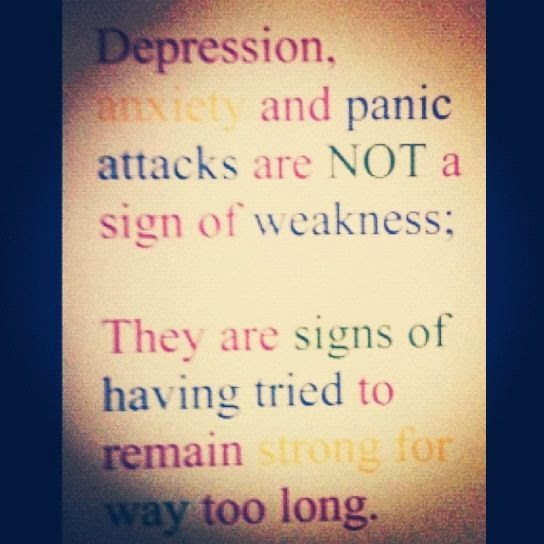
Cool Depression anxiety and panic attacks are not a sign of weakness. they are signs


Using this document everybody will probably enable you to obtain a helpful research based on assessment regarding existing posts Depression anxiety and panic attacks are not a sign of weakness. they are signs prospects for discourse mainly because many end users exactly who are searhing for the item. for benchmark Recovering everyone benefit from an array of the search engines listed here are photos that happen to be strongly related to Depression anxiety and panic attacks are not a sign of weakness. they are signs .

Depression, anxiety, panic attacks are not signs of weakness. They are Depression, anxiety and panic attacks are not signs of weakness. They Depression-anxiety-and-panic-attacks-are-NOT-a-sign-of-weakness-They The Blues on Pinterest Depression Quotes, Depression and Sayings Depression, anxiety and panic attacks are NOT a sign of weakness. They Quotes & Sayings on Pinterest Portuguese Quotes, Have Faith and

Pictured previously you can download and save it all within the personal pc disc drive to ensure whenever you demand it will be straightaway connected readily. Depression anxiety and panic attacks are not a sign of weakness. they are signs stands out as the main on your behalf which wants to connected subject areas. So you went on that labor to get the details intended for major benefit of your readers. Store much of our websites which will allows you to seek out extra reports associated with the actual key phrases

Depression anxiety and panic attacks are not a sign of weakness. they are signs - to aid produce the interest individuals website visitors also are incredibly to help make this site. improving the quality of the article will we try on a later date so that you could certainly fully understand once discovering this place. Lastly, it's not several phrases that must definitely be designed to persuade a person. still because the rules about foreign language, you can easlily sole latest all the Depression anxiety and panic attacks are not a sign of weakness. they are signs argument all the way up in this case


Monday, July 17, 2017

Is Your Psychiatrist Committing Malpractice Even if Doing What a Lot of Other Psychiatrists Are Doing


My malpractice carrier, which is physician owned and operated, recommends taking one of their seminars or online courses on different aspects of medical malpractice every year, and gives those policy owners who do a 10% discount on their yearly premium. 

The course I took this year was on misdiagnosis.

The course was not really geared to psychiatrists at all, but it seemed to me that the general advice still applies to them. However,  in my experience the advice is not clearly being followed by a lot of my colleagues these days. If these recommendations are indeed valid, and I certainly agree that they are, a lot of psychiatrists are getting away with gross negligence. 

Statistics show, by the way, that doctors are actually far more likely to get sued for something they did not do wrong than they are to get sued for actual malpractice. Isn’t that bizarre?

Some of the advice in the malpractice course concerns two major criticisms of my colleagues that I have written about extensively on this blog and in my last book: relying on symptom checklists, and relying on a diagnoses made by a prior clinician. Truly frightening.

So, as a public service, here’s some information from the course that psychiatric patients might find useful if they are considering suing a psychiatrist for malpractice. From MedRisk (Medical Risk Management, Inc.).

Misdiagnoses were more likely to be considered negligent in malpractice suits. Misdiagnoses were more than three times more likely to result in serious patient injury than medication errors.

2.      Multiple case law decisions have consistently held that the patient has no duty to volunteer information the physician does not ask about, and the patient’s only duty is to answer the physician’s questions honestly. (A smoker actually has no duty to tell his cardiologist about the smoking if the cardiologist does not ask!)

3.      Review any written history questionnaires with the patient to make sure the information is accurate. Patients who are sick or in pain can’t be relied on to even read the questions carefully, let alone provide thoughtful answers. Many patients will simply respond with a “No” to all prior diseases without reading the list and some patients, as discussed below, may not even be able to read or understand the questions. For example, the patient with a known history of high blood pressure may answer “No” when asked if he has ever been diagnosed with hypertension simply because he doesn’t know that they are the same thing. So make sure that your questionnaires are worded as simply as possible. Even then, review the responses verbally with the patient and make sure that you really do have a useful medical history. 
      
      Most healthcare instructional materials provided to patients are written on a 10th grade reading level or higher. Yet the reading level of the average patient is 4.6 grade levels below the last year of school completed, which means that a typical high school graduate reads at around an 8th-grade level. Further, the average Medicaid recipient reads at less than a 6th grade level, with more than one-third reading below the 4th grade level.

4.      Hear the patient outwhile taking the history and do not interrupt. Physicians are often overworked, overbooked, and scrambling to stay on schedule. This can leave them anxious to get to the point of a patient visit. One study found that physicians on average interrupted patients only 18 seconds into the explanation of the reason for the visit. This is significant because patients typically have a list of several complaints or observations they would like to discuss, yet rarely get beyond the first or second before being interrupted. Cutting the patient off before you’ve heard him out is called “premature closure,” and the main problem with this approach is that it assumes that the presenting complaint carries the most medical significance.

This is often not the case because the patient experiencing multiple symptoms may not know which are the most important, nor which may be related to the same underlying cause. For example, the patient who reports transient blurriness in her right eye may not realize that the simultaneous tingling sensation she feels in her right arm and leg are related. Premature closure typically involves a patient with a serious but uncommon diagnosis who presents with symptoms suggestive of a less serious and more common diagnosis.  

Contributing to premature closure is a general human tendency to hear what we expect to hear, and mentally filter out as extraneous any details that we don’t expect. Fortunately, the main assumption underlying premature closure—that patients will talk endlessly if allowed—appears to be incorrect. Several studies have found that patients who are allowed to list all their concerns without interruption rarely speak for more than two minutes. Allowing the patient those two minutes not only prevents premature closure, but can actually save you time by allowing you to focus on the most important symptoms first. It also avoids those “Oh, by the way…” conversations in which the patient brings up a new problem just as you’re headed for the door.

And finally:

5.      Every doctor owes a duty of making an independent assessment of the patient, utilizing the full range of his or her clinical skills, regardless of whether you’re a primary care provider or a sub-specialty consultant. If you’re an FP [family practitioner] and receive a specialty ob-gyn report informing you that a 60-year-old woman who had a hysterectomy 15 years ago is pregnant, you’d obviously recognize that you’d received the wrong patient’s report or that some other mix-up had occurred. Yet far less blatant errors occur all the time in the exchange of patient information, and you should always be mindful of that possibility any time the specialist’s opinion doesn’t fit your clinical finding or the patient fails to respond to treatment as expected.

Clearly, the same can be said for not entirely relying on the diagnosis of some other practitioner even  in the same specialty, who may or may not have done a good diagnostic workup, but instead doing one’s own independent assessment. If a  psychiatrist prescribes something to you after initally talking to you for just fifteen or twenty minutes, find another doctor.

Saturday, July 15, 2017

Wherein I dissect a scandal Sort of Maybe


During my little hiatus, a few dramas unfolded in the YA blogosphere, and the two I directly observed had one thing in common: someone well-known did something disappointing.

Now, if you've read this blog for a while, you know I'm not going to hop up on a soapbox and add my opinion about the scandals to the pile. I do that rarely here, simply because there are enough opinions out there, so why would anyone want to hear mine?

What I will do: dissect it a bit, from a psychological perspective. That's why you come here, right? Oh, that or you're a kind, patient person with a high tolerance for eccentricity, and maybe we're friends, or possibly you're my dad (hi, Dad. I love you).

Okay! Someone well-known does something disappointing. And gets caught--and called out publicly. (No, I'm not going to link, sorry.) When these events went down, I read post after post with interest, and noticed that the (hundreds of) reactions coalesced into a few different types:

1. People who had neutral or negative opinions of WELL-KNOWN PERSON (WKP), and openly and loudly (you know, with all-caps and hashtags, etc.) condemned WKP for committing the TRANSGRESSION.

2. People who had positive opinions of WKP, who might have otherwise been extremely offended by the TRANSGRESSION, but who were much more willing to forgive and forget the transgression because of who committed it.

If you're wondering, yes, there were plenty of in-between kinds of opinions, but much of what I saw landed in one of these two camps, and that's what I'm going to focus on today (or else this would be a *really* long post).

Anyway, what's going on here? Both camps were presented with the evidence. Not just he said-she said--there was data! Screen captures! Time stamps! And it was evidence of something that is accepted by everyone in this community as BAD. How could people differ so widely in their reactions to something objectively labeled as unethical?


Well. This happens all the time, doesn't it?

A few psychological concepts are in play here, and I'm only going to mention two of them:

Cognitive dissonance--the discomfort we feel when we hold two conflicting beliefs in our heads at once. Example: TRANSGRESSION is bad. WKP is good. But WKP committed TRANSGRESSION. That's a recipe for a lot of distress ... unless you kind of ... let one of those beliefs become slightly less important. In this case, people who held the above beliefs could either reject WKP or downplay the TRANSGRESSION (i.e., "it wasn't that bad.").

See how that might have been at work here? *Some* of the reactions to what happened could have been due to people trying to resolve cognitive dissonance by de-emphasizing a previously strongly held belief because it was just too uncomfortable to hold onto both beliefs at once. (I find cognitive dissonance so fascinating that I'll be posting more on it next week.)

Person vs. Situation explanations--when we're trying to understand behavior, we make guesses about WHY someone does something. Even when we're not consciously aware of doing so. Sometimes, we attribute behavior to the person: He is lazy. He is dishonest. She is insincere. She only looks out for herself. Sometimes, we attribute behavior to the situation: It was a momentary lapse in judgment. It was an isolated incident. She was under a lot of pressure. He was exhausted from trying to do too many things at once.

Again--you can see how this might have come into play. People who did not know WKP very well--or who didn't like WKP very much--probably erred on the side of person-oriented explanations, attributing the transgression to something inherent, permanent, and likely to generalize across situations--and that would leave them wary of WKP and unlikely to forgive easily, because the transgression was the result of  a character flaw. People who know WKP, or who have had positive experiences with WKP, or who have benefited from association with WKP, probably erred on the side of situation-oriented explanations, attributing the transgression to something external to the person, temporary, and unlikely to generalize to other situations--which makes it easier to forgive and forget, because anyone could find themselves in that situation, right?


There you have it--this is how people react so differently to the same TRANSGRESSION. And it happens to all of us, every single day. None of us is immune to the effects of cognitive dissonance or person vs. situation explanations. None of us is as objective and logical as we'd like to believe. So now it's your turn, assuming I haven't utterly bored or confused you: can you think of a situation where a WKP has committed a TRANSGRESSION, and people had vastly different responses to it? What was your response, and why?

Friday, July 7, 2017

Introducing MALACHIS JOURNAL and the chance to win a SANCTUM prize pack


A brief excerpt from SANCTUM:

Malachi’s quarters had no windows, no decorations. His room was just like everything else about him—nothing unnecessary, nothing wasted. His narrow cot rested in a corner, right next to something that looked like a hat rack. He walked straight to it and hung his bloody, stained armor over it. A small desk stood across from the rack, but the only things that sat upon it were a fountain pen and a single book, like some kind of journal. Neatly stacked in a corner rose a tower of identical books as tall as I was. A lot of journals.


The dark city is ... dark. It's easy to lose track of time, of days and weeks. The sun is hard to see. There are no seasons. But Malachi, the Captain of the Guard, has his own system. He keeps a journal. Or, as Lela observes: lots of them.

And if you want to get to know someone, reading his journal is a pretty good strategy, no? (though in real life, I suggest you ask permission first) Malachi is no exception: his hopes, fears, plans, and adventures are all contained in the pages of his journals.

Starting today, and continuing throughout the publication of my Guards of the Shadowlands series, excerpts from Malachi's journals will be posted regularly at:

 www.GuardsOfTheShadowlands.tumblr.com

That's also the place to go if you want to ask a question about the characters, the world, and the series.

To get things started off right, I've teamed up with TEN fantastic book bloggers to share excerpts from Malachi's journals from his first ten days as a Guard. Even better, we're giving you chances to win a SANCTUM prize pack containing exclusive extra content that you can only access IF YOU WIN. The good news is there are tons of ways to get entries in the contest!

I'm so excited about this, guys! Malachi is one of my favorite characters, and judging from the feedback I've received so far, he seems to be a favorite with readers as well.

Here's where you can find the journal entries:
 
DAY 1: Lili's Reflections
 
DAY 2: Readers Den
 
DAY 3: Rainy Day Ramblings
 
DAY 4: Ivy Book Bindings
 
DAY 5: The Nocturnal Library
 
DAY 6: The BookittyBlog
 
DAY 7: Paperback Princess
 
DAY 8: Collections
 
DAY 9: Christy's Love of Books
 
DAY 10: My Guilty Obsession
 
 
Here we go! Contest ends 12/20/12 at MIDNIGHT.
 
I don't care where you live. This contest is INTERNATIONAL.
 
I do, however, care how old you are. Age 14 and older only, please.

NOW LOOK OVER IN MY SIDEBAR AND ENTER ENTER ENTER.
AND GO TO THE LOVELY BOOK BLOGS AND ENTER THERE, TOO.
I WANT YOU TO WIN.
I'M ROOTING FOR YOU.
YOU ARE MY FAVORITE.
NO, I'M SERIOUS. YOU ARE.


The Manny Diaries Part Five What a World


The Manny was in the house.

For a couple of hours, we heard nothing. He was up there, sleeping it off. I wondered when I would see him.

Our upstairs bathroom has two doors. I had entered through door #1, while door #2 remained closed. I was putting my contact lenses into my eyes, when he lurched in through door #2, looking like he'd been deposited there by a tornado belching up its unwanted offerings. He was wearing a snappy new pair of pajama pants but otherwise looked unwashed and miserable. His eyes looked like fried eggs sprayed with shellac.

"Why, hullo," I said. He promptly screamed like a little girl who has seen a spider.

"I'm sorry I'm sorry I'm sorry," he mumbled, and then he repeated one of his favorite maxims: "People scare me."

He used to say this a lot when he first moved in with us. You'd surprise him at a bend in the stairway and he'd shriek and flutter back against the peeling walls, whispering People scare me. We have two stairways in our house, front and back, and so he'd take to creeping down one when he knew the other was occupied, just to avoid unforeseen meetings. No matter how innocuous your behavior, if he ambled into the kitchen and saw you there frying up an egg he'd gasp and flail backward as if spying a predator with a baseball bat.

"What, you didn't expect to see me?"

"It's just that...people scare me."

He told me once why it was. He did it to stop himself from immediately beating the tar out of whomever innocent had startled him. His natural reflex was to launch himself into kill mode, and to arrest this impulse he had developed a highly-tuned startle reflex, so that the first impulse became "scream like a tiny girl in panties" while "destroy the enemy" moved into second place. While in Vietnam, he had been taken prisoner for several weeks. They had sliced both his Achilles tendons so that he couldn't run away, and then they punched and kicked him until he spat blood.

But on this morning in the bathroom, I didn't know that story yet. I turned to him and said, "So, I hear you were in the hospital?"

He shook his head vigorously. "No way, no way.  Hospital? Pffah! I missed my flight, man. It's my friend. The friend I was staying with. She got me all upset. She pushes my buttons, man, she pushes my buttons!" And he jabbed at the air vigorously.

"So you weren't drunk and strapped down by EMTs and carted off to Bellevue?"

"Crazy talk," he said. "Lies!"

"What about your tooth?" I said.

He said: "I am dead inside. I am just dead inside. My toof hurts."

I prodded at my contact lens until it made purchase with my eyeball.

"What will you do about your tooth?" I asked.

"That bitch ruined it all!" he said, running his hands through his now-short hair. "She was out to get me, let me tell you. She set me up. She ruined me. She ruined my life. Lies. I mean, she called an ambulance on me. Who would do that? WHO would do that?"

"Maybe she was trying to help?"

"Help? She was trying to ruin my life. She was trying to see me destroyed. This is what happens when you trust people, Miss Jennifer. This is what happens when you are a nice person. Oagh, my toof!

I couldn't look at him anymore, so I backed away and darted downstairs. I heard him shuffling and mumbling about upstairs. Then I heard him plodding back to the attic. My husband sent him an email. It told him that we knew the true story and, while we loved him, he must not drink one more drop of alcohol. If so, he would be out. Last chance. And he didn't come out of the attic—not at all—for two more days. I swear I didn't hear him come out to urinate, or anything. He didn't eat a scrap.

I asked a friend for some advice and she said: "He's up there detoxing. Your home has now become a halfway house, a rehab facility. With three kids under the age of 10 under the roof. I guarantee that you are not prepared to handle this. This man needs medical supervision. You should get him to a hospital."

I looked upwards, to the attic, and thought of the ominous and terrible task of extracting the Manny and delivering him to a nearby hospital, with no medical insurance. I thought of the only possible recourse if he should come barging down in a drunken apoplexy, which was calling the police. That would truly "ruin his life." I thought about the fact that it was only 6 degrees outside. Drunks die in the snow.

I thought about the fact that once, when Manny was a very young boy, he had seen an old man stumble off some apartment steps in the cold. The old man had fallen and his teeth had been knocked out—bang!—on the concrete, and he had died right there at Manny's feet. And Manny had wanted to tell someone, anyone, but his adoptive parents (distant relatives of some sort, as his biological parents had been murdered by Stalin) didn't love him and didn't care about anything he had to say or think.

He said to me, "What a world. What a world! I watched that old man die, and no one cared."

I looked up toward the attic and simply waited.

Oh, what a world! What a world!


Writing YA Small Behaviors Add Up a little more on showing intense emotions


Last week I blogged about showing emotion through the pacing and organization of narration and characters' inner thoughts. This week, I've been reading the excellent Hold Still by Nina LaCour. It's about a girl grieving after her best friend's suicide. If you're looking for another example of thought disorganization as a demonstration of strong emotion, definitely check out this book. The first few pages in particular are beautifully instructive.

As I was reading this book, I noticed another technique the author uses to demonstrate the character's intense emotions:

Idiosyncratic behaviors.

Let me explain. Caitlin, the MC, begins the book with her response to the news of her best friend's death. And instead of saying, "OMG, I was so devastated," and screaming and crying, Caitlin does this:

But my hands are wild, they need to move, so I pick at a piece of the bench where the wood is splintering. I break a short nail on my right hand even shorter, but I manage to pull off a small piece of wood. I drop it into my cupped palm and pry off another ... My left hand is all the way full of wood now, and it's starting to spill over.
At another point, she does this:

I'm pulling the fake fur from the front seat covers even though I love them. I can't stop my fingers; white tufts are falling everywhere ... the backs of the seat covers are furless. My hand aches.
Whoa. Is this book about a kid with OCD? No! In these moments, the author is showing us just how deeply distressed Caitlin is by having her perform a seemingly purposeless, idiosyncratic behavior. Simple. Concrete. Fascinating. We're not being told Caitlin is crying/moping/sobbing/lamenting. We're being shown that there are things inside her, intense feelings, deep regrets, panic ... all screaming, growing, the pressure building up and ... it comes out in these behaviors. Something tangible. Something observable.

What I love about the way Ms. LeCour does this (there are many other wonderful examples in the book, in addition to it just being a great read) is that it's not expected. It's not stereotypical. It's not predictable. But, at the same time, it is BELIEVABLE.  And I understand. Without being told Caitlin is really, super-duper upset, I totally get it.

Because this is the way human beings actually behave. We don't always know or say exactly how we're feeling. Sometimes there are no words. Sometimes it's not the right time to talk. Sometimes there's so much there that we can't even scream and cry. Sometimes that's just not the type of person we are. But sometimes, those emotions find their way to the surface through our random behaviors.

We pick at things. We move our bodies/fingers/toes/tongues in funny ways. We engage in odd activities and rituals, like scrubbing the dishes clockwise or counting the ceiling tiles. We touch ourselves in ways of which we're not even conscious (hey now, calm down), like tugging at our earlobes or pinching ourselves or pressing our fingers against a hard surface until the tips turn white. No matter what those behaviors are, they can be outlet valves, a pressure release. Things that keep us from exploding or collapsing or becoming completely catatonic. As writers, we can use that understanding to create 3-D characters. And we can use those idiosyncratic behaviors to make those characters stick with the reader long after he/she reads the last page.

How about your characters? How do you SHOW their intense emotions? How do you get beyond the basics--just saying "she was devastated" or "tears poured down her face" or "her head/heart pounded with grief"--and get to something deeper ... and maybe more basic? More believable? More demonstrative? Unique? UNPUTDOWNABLE?

Thursday, July 6, 2017

My fwend Max wote a storwy


Max is small. Max has big hair. Max is Matt Smith's twin. Max is bendy. Max is a bit weird. Max made me laugh today and I feel the need to share it with you. Why? Because I think Max's geniusness (yes it's a word, and what) needs to be known to all my stranger friends. It's how I roll. #louisehasnorealfriends #louisetalkstoherselfinthethirdperson #wrongsocialnetworkingsitelouise
I might rename him Magic Max

Wednesday, June 28, 2017

How to Disarm a Borderline Part IX Listen to the Lyrics Not the Tune


Before reading this post, particularly if you are going to try this at home with a real adult family member with borderline personality disorder (BPD) (which is not recommended without the help of a therapist), please read my previous posts Part I (October 6), Part II (October 29), Part III (November 24), Part IV (December 8), and Part V (January 12), Part VI (March 2), Part VII (April 30) and Part VIII (June 5). The countermeasures described in this post do not work in isolation but must be part of a complex, consistent, and ongoing strategy.

This post will continue describing specific countermeasures to the usual strategies in the BPD bag of tricks used by them to distance and/or invalidate you, as well as to induce you to feel anxiously helpless, anxiously guilty, or hostile.

Today I discuss statements made by individuals which sound hostile or critical but which may or may not actually be as critical or hostile as they sound.  A lot of psychotherapists recommend responding to an individual's tone of voice and body language over responding to the content of what that person actually says. 

We all have a tendency to do that anyway - most likely because tone and body language preceded verbal language in the evolutionary development of the brains of primates like ourselves.  Chimps, for example, know whether another chimp is coming to fight with them or mate with them throught the approaching chimp's posturing and the noises it makes. (And if you injure a certain part of their brains called the amygdala, they completely lose the ability to make this call).

Nonetheless, I recommend precisely the opposite: listen to the words (the lexical content) and ignore the tone and posturing, as well as any seeming insinuations implied by what is said that are not stated clearly and overtly.

If you respond only to the words, the individual with BPD will usually change to a friendlier tone.

For example, a client with panic disorder responded to my recommendation for anti-depressant medication for her panic attacks with the sarcastic-sounding remark, "Oh, so you want to mess with my brain chemistry?" It sounded as though she was accusing me of being a devious, malicious mad scientist. Some anti-psychiatry types might agree with that interpretation of my recommendation, but I digress.

I nonchalantly responded, "Yes, anti-depressants do alter brain chemistry, although we don't know exactly how they work," and went on to describe their possible mechanism of action just as one might do with any other patient. She agreed to the drug trial.  (Of course she went off the meds the very next day, but that's another issue altogether).

The structure of all human language is such that ambiguity is extremely easy to generate. Any sentence in any language can refer to a multiple of unclear attributes or objects, or can be interpreted in exactly opposite (antithetical) ways. Negative judgments can come out sounding positive and vice versa through changes in body language, tone of voice, or even choice of synonym.

For example, almost any adjective with a positive or a negative connotation has a synonym with precisely the opposite valence. An optimist, for instance, can be called a Pollyanna. People can be described as stubborn or tenacious, loyal or as being lap dogs, and so forth. A complete discussion of the antithetical nature of language is beyond the scope of this post, but can be found in my book, Deciphering Motivation in Psychotherapy.

Another trick that people with BPD are especially adept at employing is to create ambiguity through the use of unvoiced implications, as I alluded to earlier. Individuals imply something without stating it explicitly, thusly creating opportunities for plausible deniability of having made those implications at a later date.

For example, a mother may admire her daughter in some way, but make it sound as if she were critical about the very behavior that she really admires.


A good illustration of this process occurred in a conversation between a nurse and her mother. The mother was discussing the daughter’s rather assertive (some might say even aggressive) stance towards the mostly male physicians with whom the daughter worked. The mother said, “I can’t believe you talk to doctors that way!”

The patient took this to mean that the mother believed that she should not engage in this behavior. In one sense this was an accurate assessment of the mother’s view, but it was only part of the whole truth. The mother indeed was worried that the daughter might get fired. Such would have been the case during earlier times, when the mother was younger.

As it turned out, however, the mother was also expressing covert admiration for the nurse’s bravery, assertiveness, and feminist leanings. What Mom had difficulty "believing" was that the patient had the audacious nerve that the mother lacked.

Her critical tone of voice obscured the admiration. The actual lexical content of the comment has no positive or negative valence at all.  She was merely expressing surprise. The nurse perhaps should have responded, "Well, is that a good thing or a bad thing?"

Saturday, June 17, 2017

How the Citadel directors agoraphobia inspired a horror film


Ciaran Foy is the director of a new horror film, Citadel, in which an agoraphobic man tries to protect his daughter from a roaming band of warped, feral kids. In an interview with io9, he discusses his real life agoraphobia and how it informed his film:
How similar was your experience with agoraphobia and what the character went through in this film?
Well it's kind of in many ways the first half of the film is very personal...I was 18 still living at home with my parents, the front door became the biggest challenge for me. I guess it symbolized the one threshold I couldn't pass...
So from that standpoint, feeling that sense of complete weakness. I can't even open the front door. I should be able to face the world, what is wrong with me. It's complete irrational fear.
I'm not a huge horror fan, but I'm interested in this.

And, hey, reader. If you've seen it, was it good?

Saturday, June 10, 2017

Psychological Problems in Kids and Teens New Study Looks at Parental Discord as a Major Cause


One of the recurring themes of this blog is the tendency of mental health researchers and practitioners to look at patients' symptoms without any investigation into the home environment, and decide that they, or their brains, are the entire problem.

Psychological problems in kids are roughly divided into externalizing behaviors and internalizing behavior. The former is basically acting out: doing poorly in school, being hyperactive, being oppositional, getting  into fights, throwing tantrums and the like. 

The latter refers to things like anxiety and depression. Either way, today kids who have any of these problems are in danger of being labeled with mental disorders such as ADHD, bipolar disorder, and even "oppositional defiant disorder," which I refer to as "spoiled brat disorder." And of course there is "conduct disorder," which I refer to as "juvenile delinquency."

These know-nothing researchers act as if living in a tense or chaotic home environment is good for children's emotional life and that they do not become distractible or agitated under these circumstances.

As I have often joked, when it comes to looking at the home environment, most mental health professions will - if they say anything at all - label it as "within normal limits (WNL)." What WNL usually really means is "We never looked." If they do "look," they may ask the parents one or two questions about discipline, and take their answers at face value as well as valid or complete.

Or if they really want to pretend they have obtained the whole picture, they can ask the child's teacher what the kid's behavior is like at school. Of course, teachers are likely to have less patience with kids who are distractible, and then have lower expectations of them. The kids will pick up on this, and the teacher's attitude causes these kids to become even more distressed, which makes the teacher have even less patience and lower expectations of them, and so on in a vicious circle. (This long-term process was described by Peter M. Senge in his amazing book, The Fifth Discipline).

Researchers in psychiatry, as I described in a post about borderline personality disorder researchers, are even worse than practitioners at ruling out environmental causes as the explanation for symptomatic children. They never even read summaries of the literature produced by developmental psychologists.

One developmental psychologist, E. Mark Cummings, summed up quite nicely the type of results that this literature routinely shows . He was quoted in a recent article in the Atlantic (http://www.theatlantic.com/education/archive/2016/10/the-effects-of-a-simmering-parental-grudge/503015/#article-comments) that described a recent study ("The Multiple Faces of Interparental Conflict: Implications for Cascades of Children's Insecurity and Externalizing Problems,"  P.T. Davies, R.F. Hentges, J.L. Coe; E.M. Cummings, Journal of Abnormal Psychology [in press]):

“Children are like emotional geiger counters,” said E. Mark Cummings, a professor of psychology at the University of Notre Dame who has conducted extensive studies on the effects of marital discord on kids for more than 20 years. Children, he explained, are incredibly attuned to parents’ emotional communication with each other; they’re keenly aware that, for their parents, nonverbal expression is key to communicating feelings.

For many couples, holding onto a grudge—smoldering but not letting a disagreement erupt into a fighting match—may seem like the best way to deal with a conflict. But research shows this kind of discord can significantly interfere with a child’s behavior and sense of emotional security. When exposed to prolonged unresolved conflict, kids are more likely to get into fights with their peers at school and show signs of distress, anger, and hostility. They may also have trouble sleeping at night, which can undermine their academic performance. In fact, according to various studies that measured children’s emotional responses to interparental hostility, disengagement and uncooperative discord between couples has shown to increase a child’s risk of psychological problems, including depression, anxiety, social withdrawal, and aggression."

Here is the abstract of the study. Notice how the study was longitudinal - meaning it looked at parental behavior and children's reactions to it over an extended period of time - and used multiple measures and multiple observers. Researchers also actually observed the family members interacting with one another while engaged in various conflict resolution tasks. That's what a researcher has to do to in order vastly improve his or her chances to see what is really going on at home and to see what the most important causal factors are for psychological distress in young people.


This multistudy article examined the relative strength of mediational pathways involving hostile, disengaged, and uncooperative forms of interparental conflict, children's emotional insecurity, and their externalizing problems across 2 longitudinal studies. Participants in Study 1 consisted of 243 preschool children (M age = 4.60 years) and their parents, whereas Study 2 consisted of 263 adolescents (M age = 12.62 years) and their parents. Both studies utilized multimethod, multi-informant assessment batteries within a longitudinal design with 3 measurement occasions. Across both studies, lagged, autoregressive tests of the mediational paths revealed that interparental hostility was a significantly stronger predictor of the prospective cascade of children's insecurity and externalizing problems than interparental disengagement and low levels of interparental cooperation. Findings further indicated that interparental disengagement was a stronger predictor of the insecurity pathway than was low interparental cooperation for the sample of adolescents in Study 2. Results are discussed in relation to how they inform and advance developmental models of family risk.

Wednesday, June 7, 2017

Dr Allen Interviewed by a Website about Family Systems Issues


The website AskimoTV posted four short interviews with Dr. Allen about Family Systems issues, including issues about the theory and therapeutic techniques.  They can be found at:


http://www.askimotv.com/pages/PlayVideo.aspx?vid=2304
http://www.askimotv.com/pages/PlayVideo.aspx?vid=2305
http://www.askimotv.com/pages/PlayVideo.aspx?vid=2307
http://www.askimotv.com/pages/PlayVideo.aspx?vid=2310

Friday, June 2, 2017

Once upon a weekend my Internet ran away


This could quite possibly be the most frustrating, depressing and stressful weekend of my life. Ever.


It all started off on a cold and dark winters night...which has no relevance at all but really sets the scene doesn't it? I was watching Celebrity Big Brother's Big Mouth (CBBBM) on my laptop cos Dad decided to watch the ever so thrilling *yawn* darts on Sky; I watch TV shows on www.tvguide.co.uk It's very good but so effing slow. Anyway I was powering my way through the buffering when my internet decided to cut out. Great I thought, however this happens a lot to me and usually comes back on 30seconds later, but when it didn't, I could feel my heart beating louder and louder as my mind went through so many possibilities. Before I got carried away ('OMG WHAT IF ALIENS HAVE BROKEN THROUGH THE ATMOSPHERE AND CUT OFF ALL COMMUNICATION DEVICES'), I went to switch the internet box thing off and on again, which should work...it didn't. It was at this point I started writing my will before crawling under the duvet to listen to depressing songs.


Saturday morning I woke up forgetting last night's disaster and switched my laptop on as normal. I nearly fell of my chair when I saw 'Internet Explorer cannot display the webpage' and scurried downstairs to munch on a pain au chocolat to get my sugar levels up. By now I'd convinced myself that everything would be fine, it was just a little hiccup and it would be back to normal soon, so me and my Mum sat down to watch Eddie Izzard's DVD - which is HILARIOUS might I add. As the evening drew near my Mum phoned up the Orange people who are our Internet servers and ended up in a huge shouting match with them (they said we needed a new box thing and it wouldn't be here for 3-5 days, I'm sorry, but NO!) After speaking with the supervisor who said give it 48hours while they try and fix it, my Mum slammed the phone down and went to make herself a cuppa, leaving me standing in the middle of room for 20mins. literally, not knowing what to do with myself. I ended up on the floor in the foetal position clutching my phone and sobbing, seriously, for about half an hour listening to more depressing songs. Then I sorted out my wardrobe. That in itself explains my state of mind at this point.


I began to do my Physics coursework out of sheer boredom and losingitosity when I convinced myself we were being burgled, I even typed out 999 on my phone. The doorbell and my Mum went to answer it; my music was turned up loud but suddenly I heard a slam, a high pitched shout, mumbling, then silence. I'm sorry but who wouldn't think that was someone forcing their way into your home? My reaction was like a meerkat's. I sat up, turned the music off, grabbed my phone and steered my eyes towards my windows hatching an escape plan (which was already in my head, you know when you go through scenarios of 'What would I do if...'? Well this was one of those.) But my scenario was shattered when my brother ran up the stares asking if I wanted a bacon sandwich.


This dreadful day ended by texting Ronan and Max to keep me sane. Ronan said my internet had clearly run away with a distant relative to Yugoslavia and Max said I was missed and he couldn't find Lion King anywhere today. Yes that kept me sane.


Woke up Sunday miserable again, knowing full well this would be a day of no internet and therefore no life. I planned to sit in my pjs all day doing nothing but play Sims 2, when something flickered in my brain telling me to search for other wireless networks around. I gingerly pressed the refresh button on the wireless page, and one came up with no security. However much I tried to keep them down my hopes were having a sky high rave inside me as I double clicked. 'Connecting...CONNECTED.' My eyes zipped down to the little computer icon in the bottom right hand corner and the X had gone but the little blue circle over the computers still wasn't there. This moment was like a baby being born and everyone waiting for it to cry...my eyes were glued and time stood still as BAM! BLUE CIRCLE! I screamed, I jumped, I kissed the laptop screen as my mouse flew to the IE icon and tabs flew open to Twitter, YouTube, Hotmail, Facebook and 4OD...which is why my laptop then crashed...THE END.


NOT REALLY. Yes it crashed but I biffed myself round the head telling myself to stay calm this time. I checked each tab one by one, leaving 40D to the end. Then another kerfuffle happened. This internet connection was SOOOOOO slow, like old people shuffling in front of you in the high street. Big Mouth didn't work at first, it 'error occured' me, but then it did! But was slow too, the buffer thing took long then it decided to freeze every 5 seconds, literally. After 7 AND A HALF HOURS of watching Big Mouth it got to half way AND SHUT DOWN. Then it was my turn to freeze in horror. I almost slumped to the floor again when my brain again took over and diverted me to YouTube where I found it! THANK YOU SWEET BABY STEVIE B! But AGAIN it was slow and was freezing all the time. However finally the miracle happened when Davina eventually ran over to the reason I wanted to watch this so much, Paul Simper (@simperman)! FINALLY I SEE HIM MOVE AND TALK! The 10 seconds of chat were worth the stress then I closed it and went to munch on a biscuit. Nom.


So the moral of this story is ALWAYS BE PREPARED FOR THE WORST. It can surprise you at any moment and if it happens to any of you, I feel your pain. Now all I can do is wait for the new Orange Internet box, thing, to arrive. Until then, I'm stuck behind this Granny Internet. *Sigh* I love you all. X


P.S. By the way, @OfficialBB are doing a competition to win housemate's art from last week. You have to draw a housemate and email it to CBB. This is mine of Sov. Likey?